
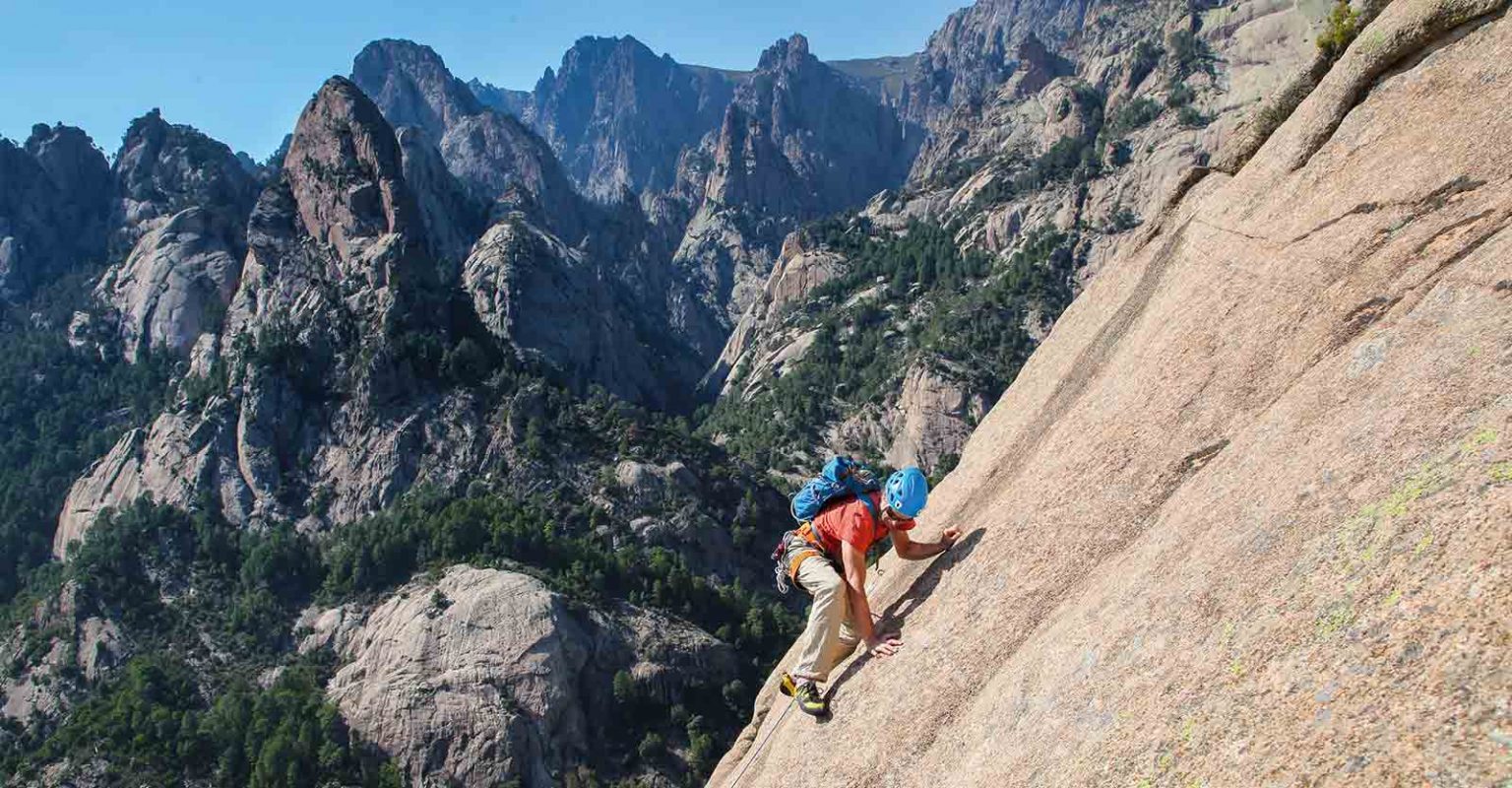
Bavella, a true climbing paradise...
Whether you’re into long multi-pitch routes or single-pitch sport climbs, fully bolted lines or trad climbing, Bavella has something for every climber, whatever your level or preferred style.
Bavella really is a climbing paradise – no exaggeration!
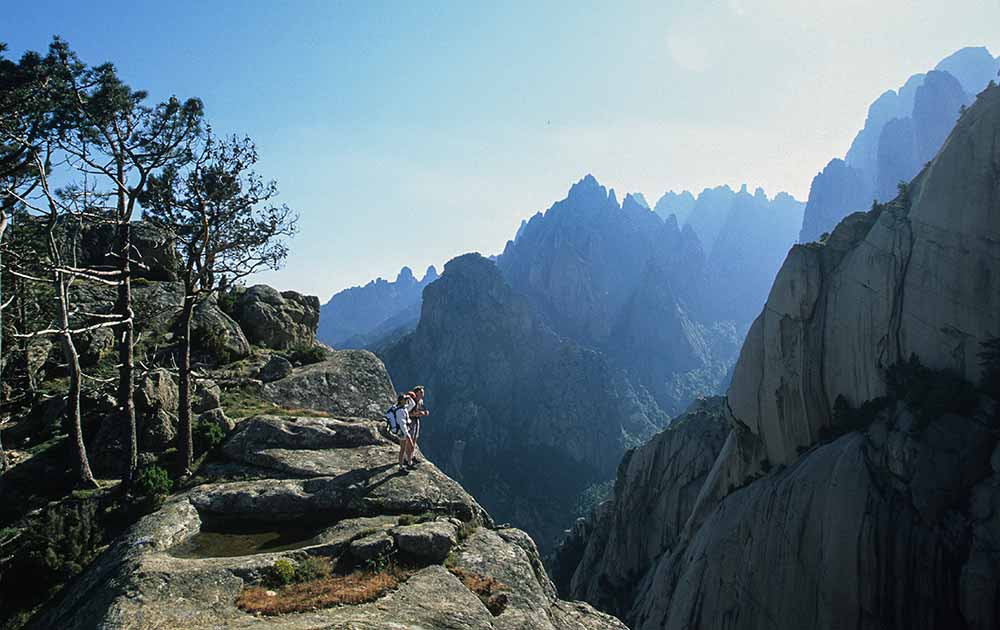
At first glance, Bavella is an immense, magnificent and disordered entanglement of needles and ravines. Then the Tafunata di Paliri and the Punta di l’Acellu logically stake their place.
More discreet faces, pillars, and summits rise little by little out of anonymity and seduce our souls as climbers: the purity of the lines on Petra Sulana, the mirror on the Specchju or the chaotic tafoni lace on the Punta Rossa.
And then further down, a massif within the massif, the attractive and intimidating Teghje Lisce with their lines that are too pure to be easy.
Each Punta, each ravine has its own personality and together they make up the singular soul of this massif, which always draws us back here to climb at Bavella.
.
The two guidebooks for climbing in Bavella
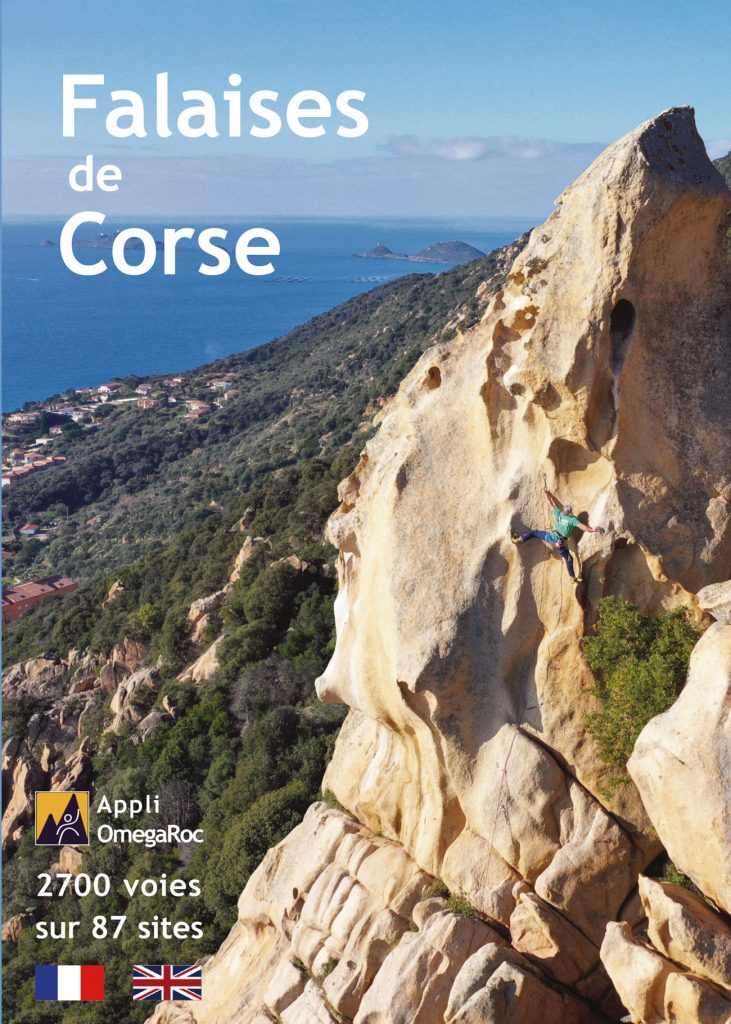
Falaises de Corse – Sport climbing crags in Corsica:
All the sport climbing crags on the island. More than 2,700 routes across 87 sites, with climbing available year-round.
Bavella – Corsica – Multi-pitch climbing in Bavella :
A wide selection of multi-pitch routes in the Bavella massif, ranging from pure trad to fully bolted routes, and covering all grades. Includes the sport climbing area at the Col de Bavella.

MULTI-PITCH CLIMBING
A little off the beaten track and well-protected by the maquis, the sounds of the world reach us as muffled remnants, and the great waves of exaggeration that hurl themselves at certain cliffs on the continent abate to a small swell by the time they reach us here. Just enough to fuel a little diversity and avoid hegemony. Slowly but surely, but not in any hurry, Bavella is being enriched with new routes, and this slower pace still today allows modest climbers to dream of first ascents.
The Bavella massif lies at the southern end of the great mountain spine that runs the length of Corsica. Routes range in altitude from around 400 m (Castellucciu d’Ornucciu) up to 1,800 m in the Aiguilles (Needles of Bavella).
With such a range – and by choosing your aspect – there’s always a good season for climbing in Bavella… although the intense heat of summer does require a bit of thought and planning.
Beyond difficulty and heat tolerance (which vary from climber to climber), other key factors to consider are the type of protection, the climbing style, and the length of both the route and the approach hike.
Styles of Protection
To understand how protection styles have evolved in Bavella, a brief look back at the history is essential.
For a much more detailed information, see: History of climbing in Bavella.
“Historic” Routes
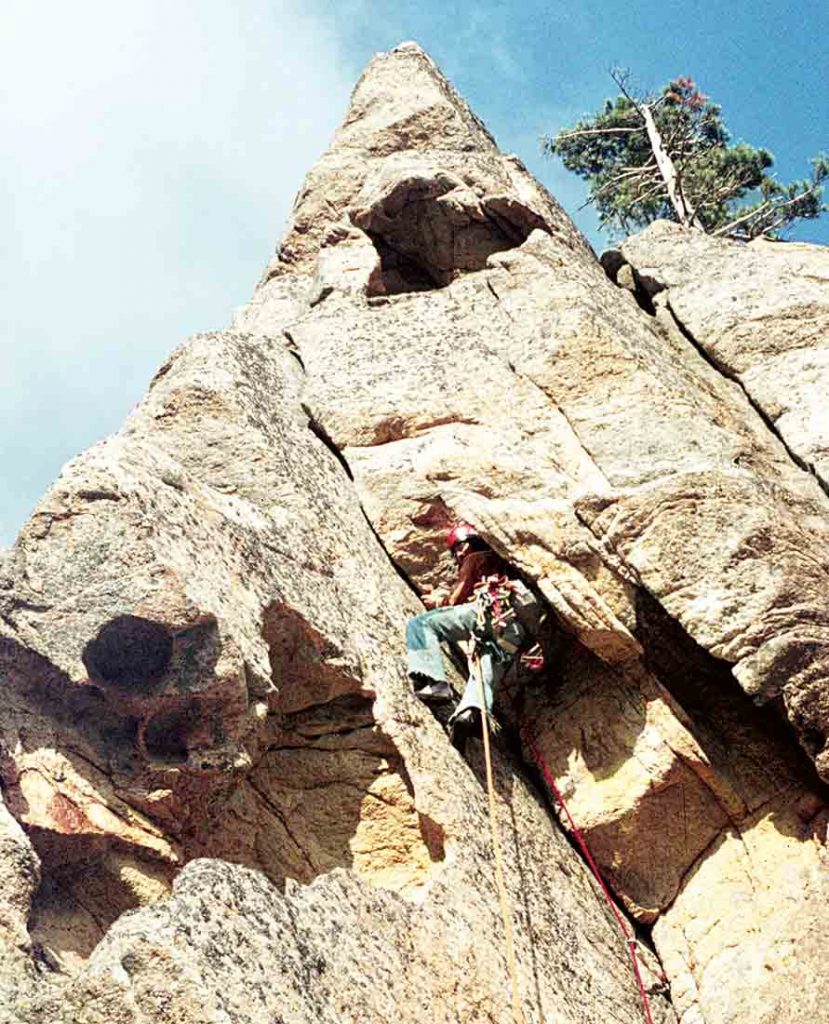
Unsurprisingly, the older routes were established using nuts, with occasional pitons and sometimes a hand-drilled bolt. Some of these lines – now classified as trad – have been forgotten, others have become classics (Arêtes de Zonza and Arêtes de Quenza, Masino, the Pilier Sud de Petra Sulana …), while a few had their moment of glory and are now waiting for a comeback (Arete Ouest de la Samulaghja, Voie Vic-Carpentier…).
Then there are the true “adventures”: long, sometimes very long routes, and above all extremely remote, deep in the Pulischellu valley. Most were established by the first “Marseillais” team. To preserve their adventurous character – and to protect the upper Pulischellu gorge – these routes are not listed in the Bavella Corsica guidebook. You have to dig around, search, and put together information… and then walk, sweat, get lost, and maybe climb – pure joy!
The Modern Era
Then came the cordless drill – something the local route establishers liked a little, then a lot, then passionately, then madly… and finally not at all. That may be a slight exaggeration, but it’s not far from how things actually evolved.
In the 1990s and 2000s, fully bolted routes began to flourish, and friction slab climbing became something of a local specialty. The widely spaced bolts of the early routes (like Dos d’Éléphant, 1985 version) gradually moved closer together as battery performance improved. Le Dos (in its re-re-equipped version), Jeef, Aguirre, Acqua in bocca, La Célébration du lézard, and many other “ready-to-climb” routes became stars.
The process seemed unstoppable, with no real limits in sight.
Back to the Roots?
From the mid-2000s onwards, however, a number of climbers – mostly locals – began returning to the basics. They put away the “infernal machine” and started establishing new routes in pure trad style. Since then, things have settled down, and a kind of balance seems to have been reached. Each year, new routes are still being developed, mainly trad, though often with a few well-placed bolts where it makes sense.
This brief historical overview leads to a simple conclusion: whatever style of protection you’re looking for, you’ll find it here. That said, a fully bolted route does not mean a “sanitized” experience. You still need to be comfortable with a certain level of commitment between bolts – especially on slab climbs.
Not sure about your abilities?
If you’re in doubt, or if your experience on multi-pitch routes is limited: take it easy.
Start with some of the well-equipped classics on the Punta d’Arghjavara (Altore, Torre di l’Alba, Conquistador) or on Punta Macao.
Climbing Styles
Tafoni and slab climbing are the two traditional specialties of the Bavella massif. However, in recent years, cracks of all sizes have been developed, and crack gloves are now often an essential part of the gear.
Tafoni Climbing
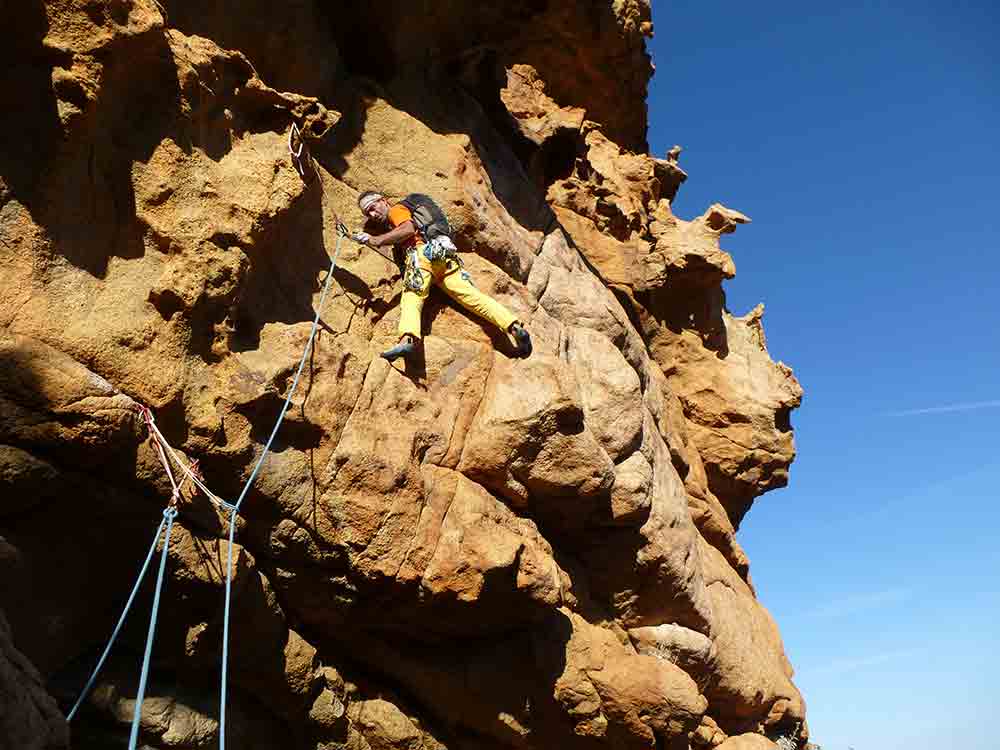
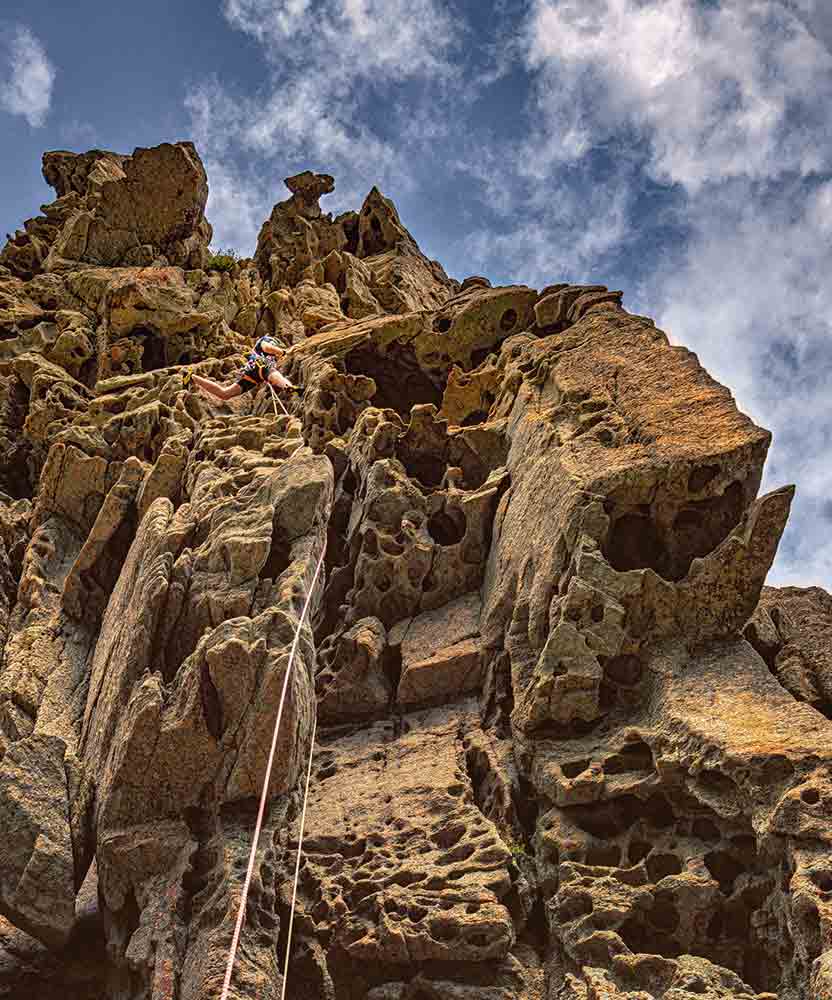
Tafonu (plural:tafoni) : Holes in the rock formed by cycles of water exposure and drying, intensified by salt carried in by sea breeze. Ranging from large cavities big enough to shelter a group to the finest lace-like formations, tafoni come in all shapes and sizes, often interconnected in a honeycomb pattern.
Climbing on tafoni is the most enjoyable but also the most intimidating. It’s essential to approach it gradually, and with experience, to learn how to distinguish between good tafonu and poor tafonu – the kind you admire but take care not to put weight on.
In this type of climbing, which can sometimes be overhanging, protection is often slings on threads. Their strength is not always obvious, and they can sometimes be very sharp. Prefer rope loops or thick slings for protection.
For a first taste of tafoni climbing, head to the crag area at the Col de Bavella, especially the Oriu Left or Campanella sectors. Routes like Tafonite Aigüe or Luce turchina on the Pilastru di l’alba are must-dos!
Slab climbing
This is the style of climbing that has defined Bavella for decades. Its popularity was made possible by the advent of the cordless drill, which allowed climbers to move away from relying on cracks for protection.
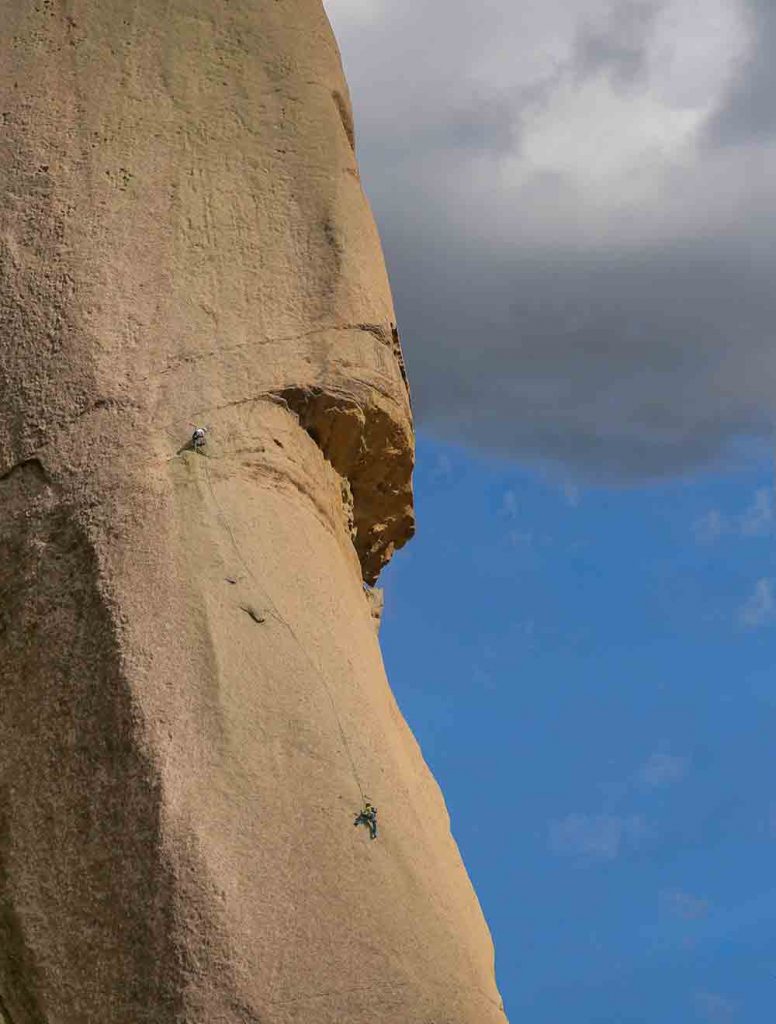
Bavella’s granite offers excellent friction, but when the rock steepens and there’s nothing left to pull on, the more unpredictable nature of this style really comes into play. These sensations are heightened by the often widely spaced protection. Commitment thus becomes an important factor in assessing the true difficulty of a route.
In Bavella, the rightly named Teghie Lisce (“Smooth Slabs”) is the ultimate showcase of this style of climbing.
For those looking to experience the delicate challenge of slab climbing, these are suggestions in order of increasing difficulty (this is by no means an exhaustive list):
the routes of Arghjavara and the Crête des Terrasses, Alexandra, Canistrelli, Petra Tonda, Le Dos de l’éléphant, La Célébration du lézard, Storia d’acqua è di luna, and Octogénèse.
Crack climbing
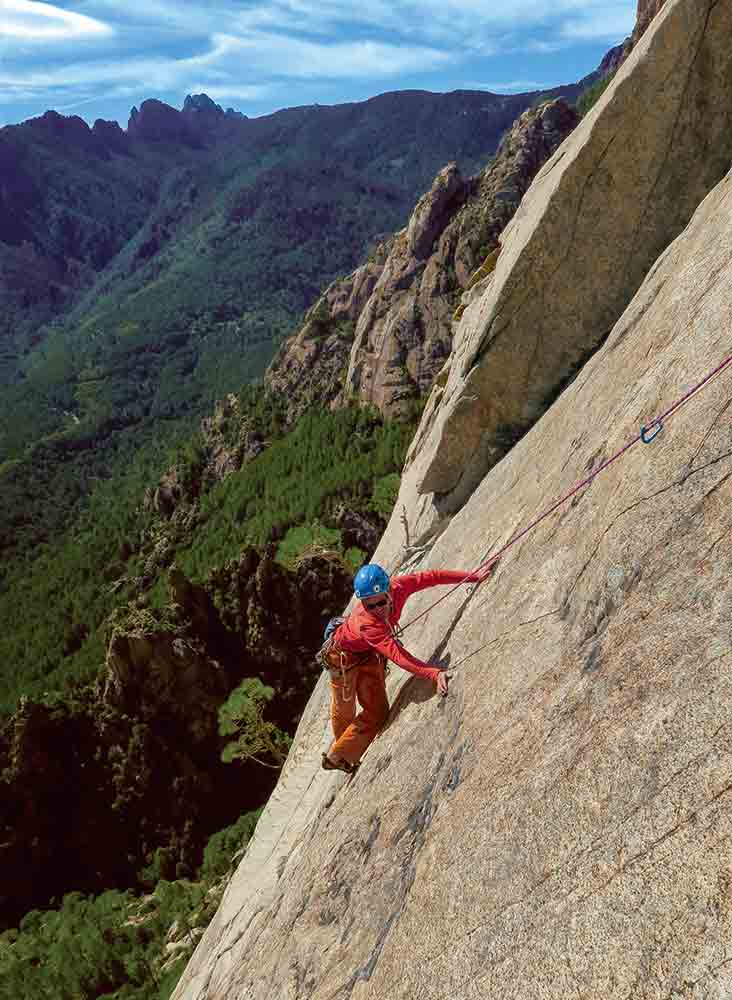
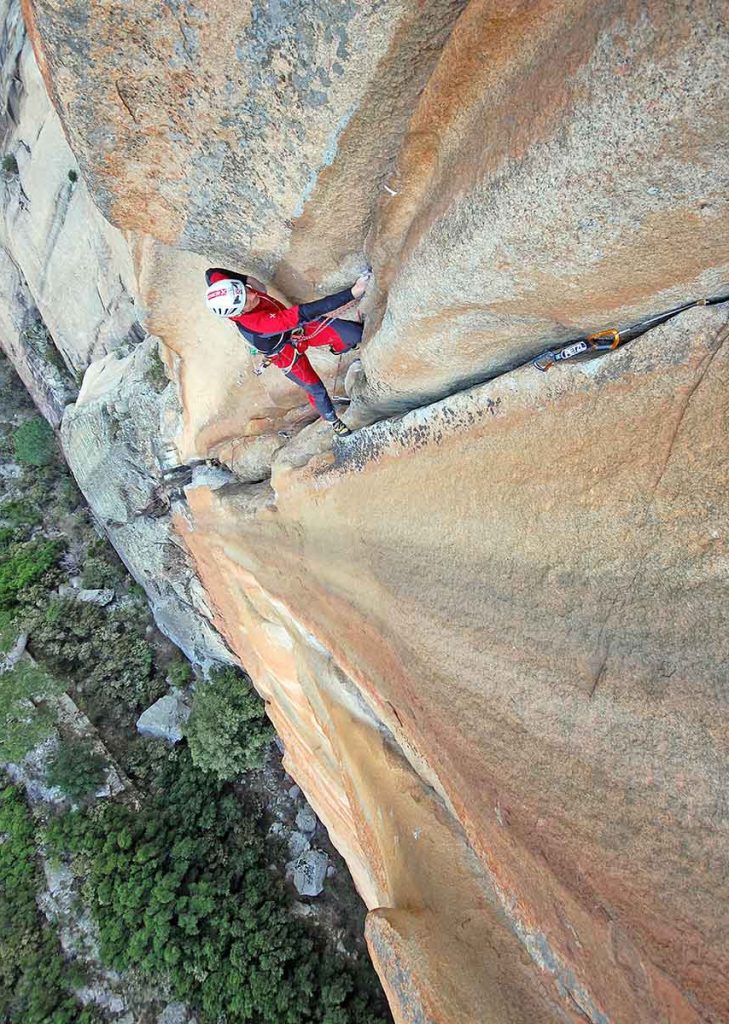
The jamming technique – essential for climbing cracks of “standard” size – was virtually unknown in Bavella until relatively recently. As a result, this style of climbing did not really develop, despite the obvious lines that streak across the Bavella granite*. Only the exhausting laybacks, chimneys, and various more or less bold offwidths were explored. The most famous is the fourth pitch of Porte des cieux, now partially bolted.
The first truly crack-oriented routes were established at Lunarda by JT Casanova in the 1990s, using mixed protection. Over the past twenty years, attitudes have changed: some climbers have learned the art of jamming and started chasing the best spliters. They have established several pure crack lines, often entirely free of bolts. These routes are generally quite challenging – there’s nothing easy about them.
If you’re into crack climbing, Bavella offers every type: from the cleanest, straightforward crack to the most flared one (where jamming and placing protection becomes an art), and from thin finger cracks to exhausting offwidths.
* Since then, the developments by Precht have been gradually rediscovered, some of which appear to be exemplary in this style.
Some must-do crack climbing routes in the Bavella massif:
La Masino, Mal’Cunciliu, the routes of Les Deux Sœurs (in the valley of the same name), Crack’age, Nirvana, Les Ans volés, Abbastanza, Parfum de violence, La Nécessité du voyage, De Rerum Natura, and Sintomi Strani.
SPORT CLIMBING CRAGS
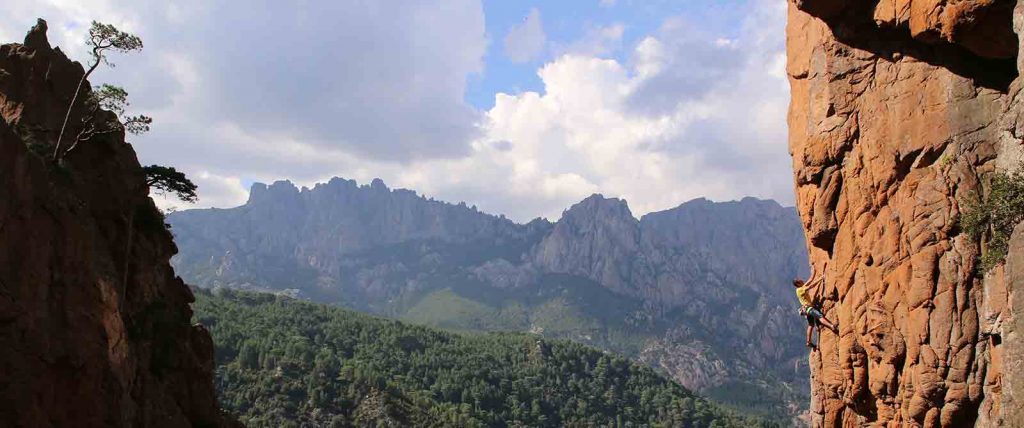
In a landscape dominated by hundreds of multi-pitch routes, single-pitch climbing has long been the neglected sibling – especially at the higher grades.
The Col de Bavella area, with its fifteen or so sectors facing in different directions, has for decades satisfied climbers in the 5th and 6th grades, but it has long lacked harder routes.
However, over the past fifteen years, many new crags have been developed within the Bavella massif itself and in the surrounding areas, several of them offering high-level climbing.
Take a tour of the single-pitch crags in and around Bavella, organized by grade.
In parentheses, you’ll find the typical grade range for each area.
More information is available by clicking on the name of each crag via the OmegaRoc web app.
Malaspina ( 3a – 6a).
Main bolter: Adrien Boulon
This area features a true beginner-friendly crag, with numerous routes in the 3rd and 4th grades. The protection is generous, and the climbing is very enjoyable. The crag is in the shade in the morning.
You’ll also find a few easy, fully bolted multi-pitch routes – still ideal for beginners – as well as a sector that stays in the shade all day (Jerba), offering slightly harder grades.
Another highlight of the area, perfect for rounding off the day: the nearby river, before heading to the bar at the Ponte Grossu campsite for a drink or a bite to eat.
Le Col de Bavella (4c – 7a)
Main bolters: Many, including Jean-Paul Quilici. Fully re-bolted by Carlos Ascensao
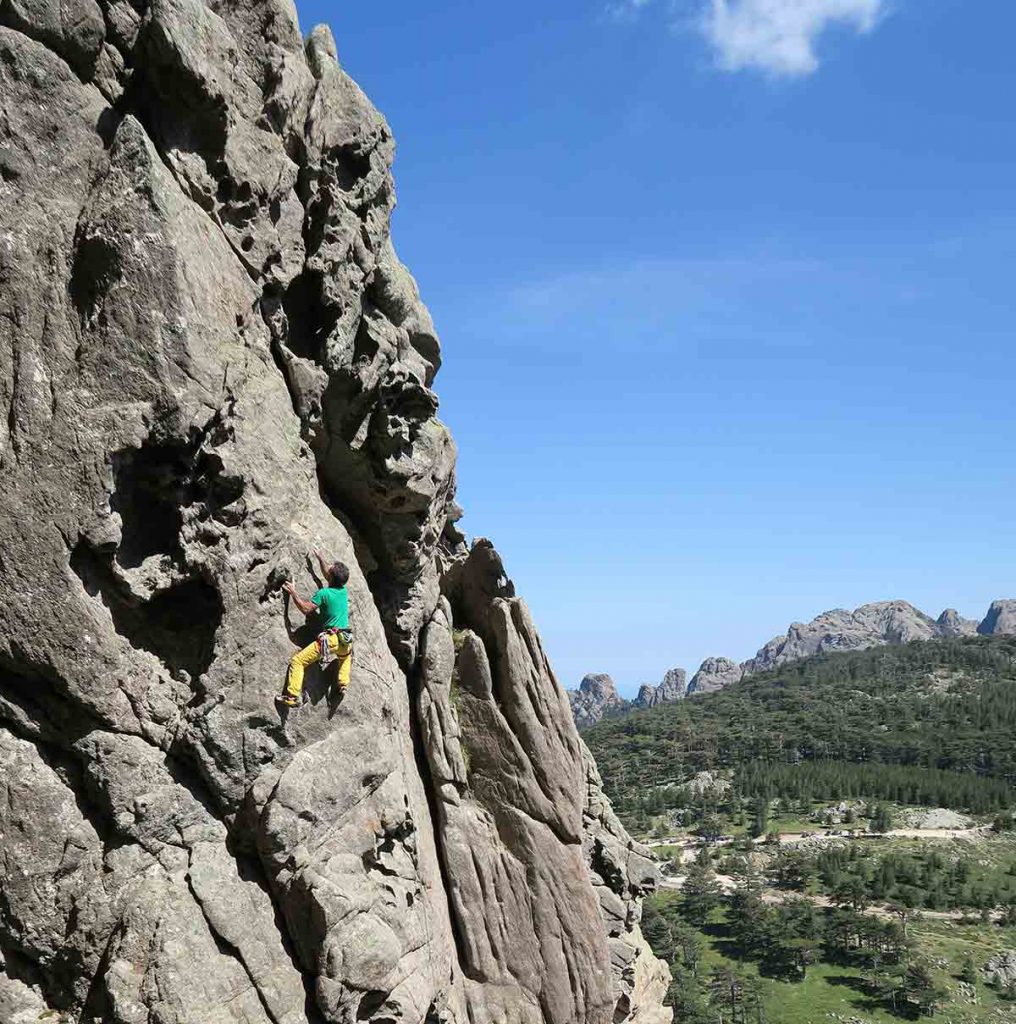
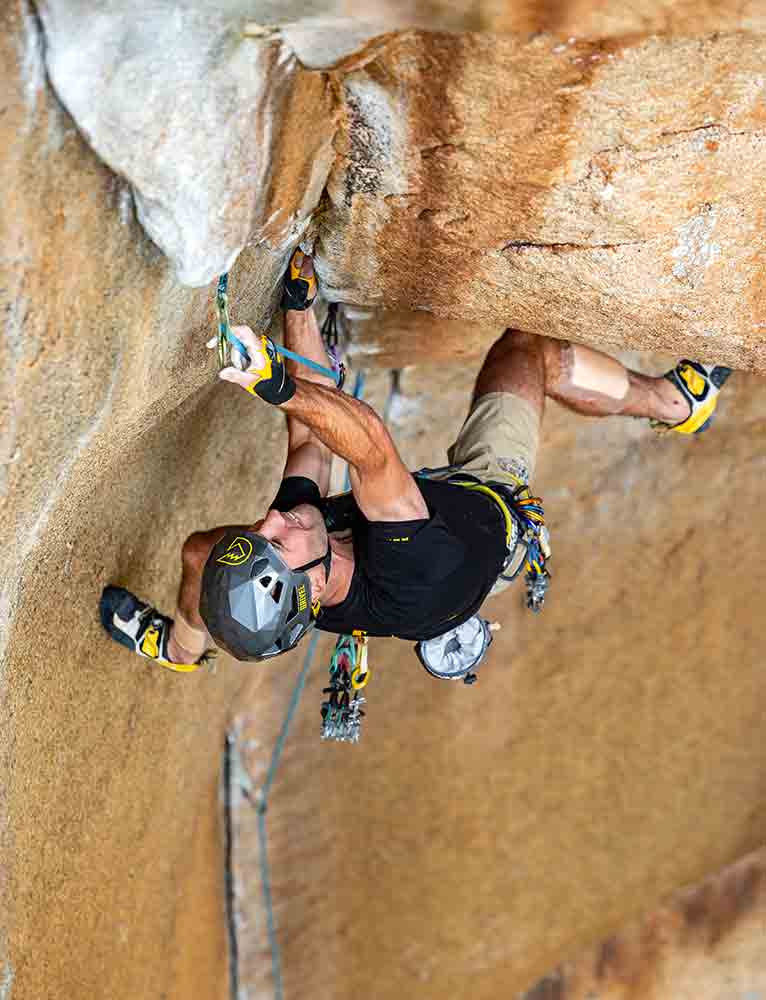
With around 200 single-pitch routes spread across nearly 15 sectors, this sport climbing area at the Col de Bavella is a must-visit for climbers from 4b to 7a. The setting is stunning, and the superb, varied rock reflect well the climbing-styles in the massif, alternating between spectacular tafoni and technical walls or slabs. Its many different aspects make it possible to climb all day and almost all year round. An exceptional place. In summer, the only drawback is the noise from passing cars.
This area is very exposed to the wind.
A Vacca (5b – 6b)
Main bolter: Carlos Ascensao
These routes are developed on superb granite with excellent friction, though it is quite abrasive. Carlos Ascensao has equipped around fifteen quality, non-elite routes, but the south-facing aspect unfortunately makes the area less suitable in summer.
Ciuffatu (6a – 6b)
Main bolters: Guy Tomasini and Adrien Boulon
A handful of beautiful routes located right by (or almost by) the river. Unfortunately, the rock is very sandy for the first 10 meters.
Ponte Grossu (6a+ – 7c)
Main bolters: Nicolas Nastorg and Adrien Boulon
This crag, just a one-minute walk from the car, offers varied climbing that is often technical. A few crack lines also allow you to try your hand jamming technique.
In summer, the nearby river provides a welcoming place to cool off during the hottest hours of the day, and the campsite bar is the perfect spot for a final refreshment.
La Sentinelle de la Vacca (6c – 7b)
Main bolter: Adrien Boulon
A 45-minute approach leads to eight very beautiful routes in a stunning setting.
The climbing is either on technical walls or on overhangs – very physical and pumpy.
Punta Chjapponu (6b – 8a)
Main bolters: Guy Tomasini and Jeff Andreucci
Punta Chjapponu is one of Bavella’s promising crags, though its development has been somewhat slow.
With its 12 routes, Punta Chjapponu is already well worth a visit. The routes are set on both sides of a gully, so there is always a wall in the shade. It is also from here that Linea d’Ombra, a classic multi-pitch route in Bavella, begins.
La Baraka (6b – 9a)
Main bolter: Adrien Boulon
Only nine routes, but this is where you’ll find La Baraka, an exceptional trad crack line – graded 8a nevertheless.
Le 3G (6c – 8b)
Main bolter: Adrien Boulon
The 3G may be the most beautiful “hard” climbing area in Bavella. It is made up of two sectors:
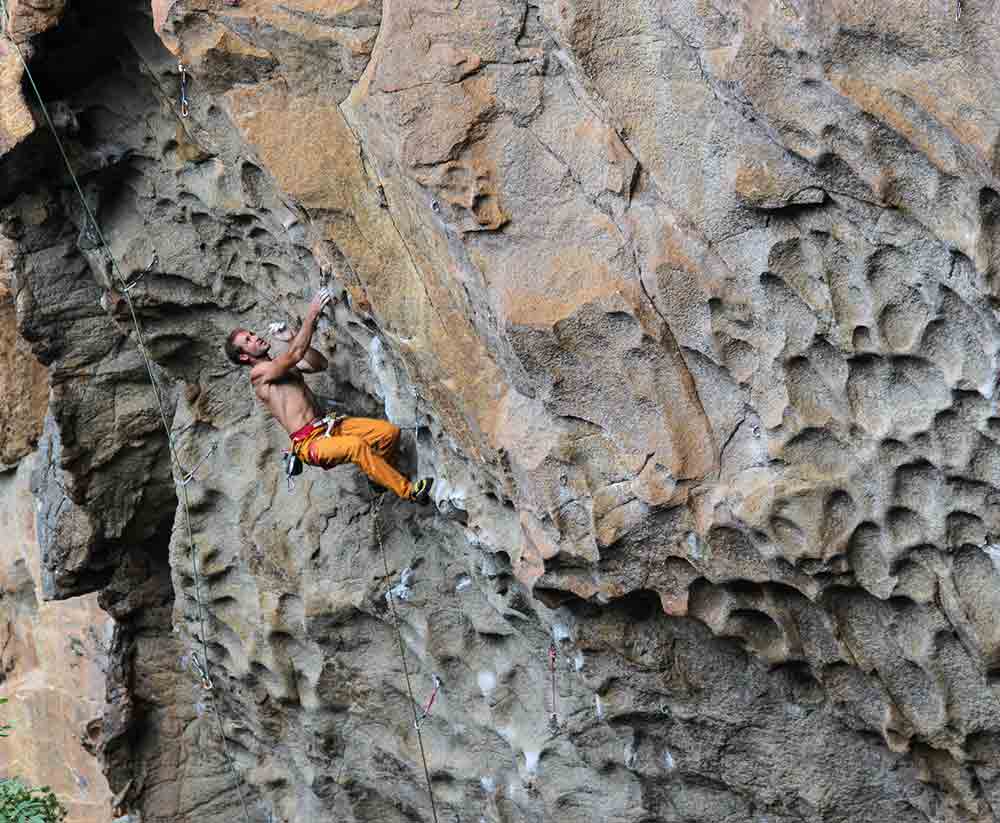
The 3G, with often long and spectacular lines, offering a wide variety of profiles and styles. Climbers must learn to master the sloping forms of eroded tafoni, as well as a perfect roof – something quite rare on granite.
The 3G+ sector is smaller, but the routes are superb vertical lines. The two 6b routes are exceptional!
Mescaline (7b – 8b)
Main bolter: Nicolas Nastorg
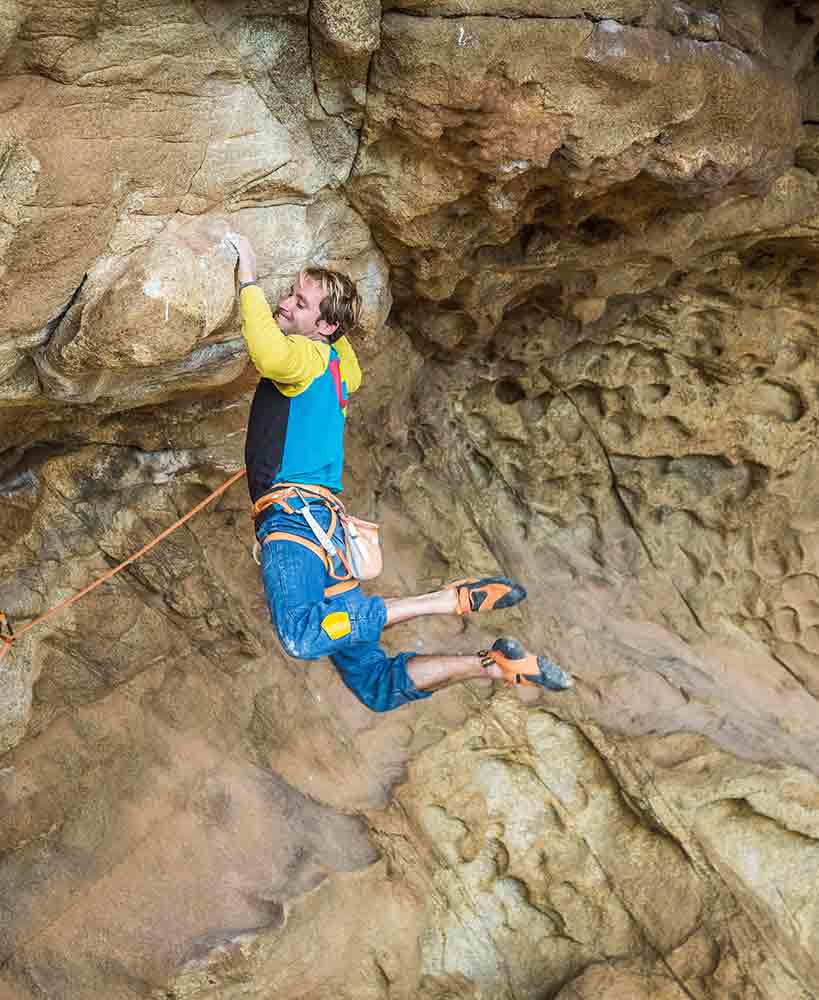
The Mescaline cave has only nine routes, but six of them are graded 7c or harder. The climbing – on steep overhangs, even roofs at times – features excellent rock. It is very varied and always physical, sometimes with a few tricky bouldery moves.
A major advantage: the cave stays in the shade all day, making it climbable throughout the summer.
And since it’s a cave – or almost one – it can also be climbed in the rain.
A Cupulatta (6c-8c)
Main bolter: Adrien Boulon
Just 14 routes, but of very high quality, on volumes that only granite can offer.
The irregular overhangs demand athletic, sustained climbing on sloping holds, punctuated by a few bouldery moves.
In summer, the crag is in the shade until around 2 p.m.
Le Barring (7a – 8b+)
Main bolter: Adrien Boulon
Le Barring is the first granite crag in Corsica to feature such a density of high-level routes. The climbs are (very) long, with power endurance sections on slopers, and even the easiest routes are beautiful.
Le Vallon des Sœurs (6b-8c)
Main bolter: Adrien Boulon
On the harder routes, the climbing is on steep overhangs – very physical, of course, with a tendency toward power endurance and bouldery sections.
Note that there are very few routes in the 6c–7b range, but that’s fortunate: the crag appears to still have strong potential for more routes at this grade. For now, however, it remains just a potential.
Punta Bigornu (6a-7b trad).
Main developer: Jeff Andreucci
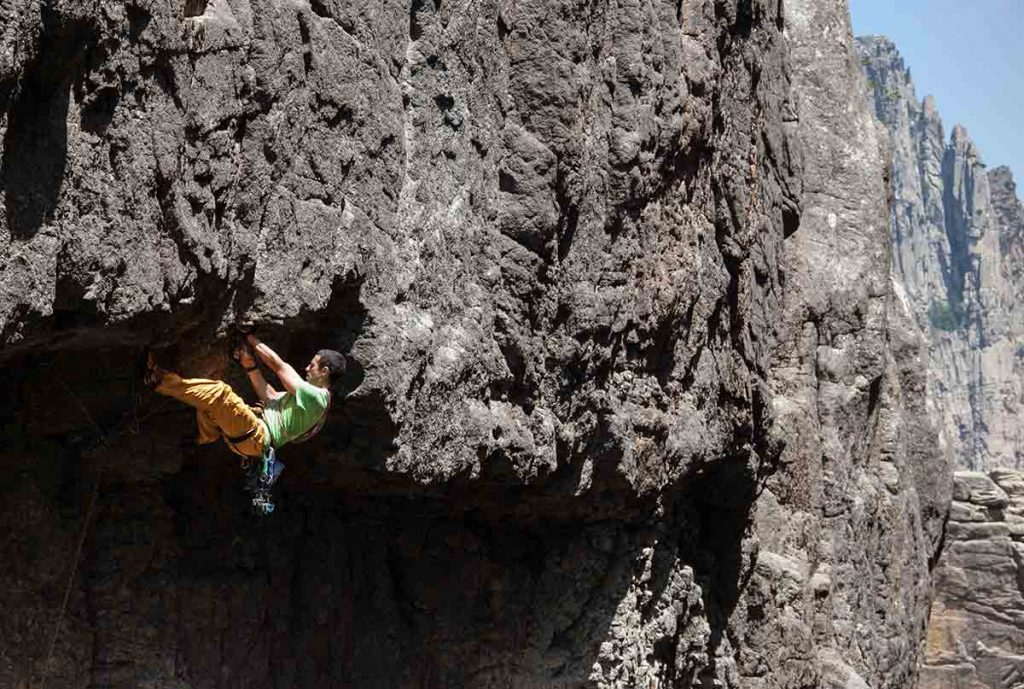
The Punta Bigornu canyon is the most significant single-pitch trad climbing area on the island.
Around thirty routes allow you to place gear on very dark, compact granite that is surprisingly well suitable to natural protection – provided you’re creative. A few bolts have been added where necessary, and all belays are bolted.
In addition to its elevation (around 1,400 m), this perfect canyon always offers at least one face in the shade. Punta Bigornu is an ideal crag for summer climbing.
BAVELLA IN THEIR WORDS
Before you too fall under Bavella’s spell, here is a small, non-exhaustive selection of words from some of the massif’s lovers.
Open your eyes; look closely; notice the effect of the light on the aretes, the blue shade of the ravines; listen to the streams; taste the water from the sources; smell the cistus bushes and the maquis; enjoy the place and the moment; take your time; admire…
Bavedda has held my heart for more than 40 years.
Jean-Louis Fenouil
Open your eyes; look closely; notice the effect of the light on the aretes, the blue shade of the ravines; listen to the streams; taste the water from the sources; smell the cistus bushes and the maquis; enjoy the place and the moment; take your time; admire…
Bavedda has held my heart for more than 40 years.
Jean-Louis Fenouil
Even though nowadays you would have to be naïve or uncultured not to class Corsica – and Bavella in the first instance – amongst the major destinations in the climbing world, this was not at all the case at the beginning of the 1970s. (…)
A friend had fired up my imagination by showing me the existence of a wild valley, filled with walls of dimensions that were unseen elsewhere on the island, and above all, untouched. This is how we discovered the Pulischellu. “Of poignant beauty and wildness – conjuring up fantastic images of Conan Doyle’s Lost World – U Pulischellu is a universe apart, where each climb is an adventure”, I wrote in my Bavella guidebook in 2000. From the summer of 1975 onwards, swayed by the discovery of the valley and the first ascent of the Arête de l’Ecureuil on the Punta Pulischellu, U Pulischellu became my secret garden. As if I was under the influence of a magic potion, I was drawn inexorably towards it. I paid it around a dozen lovestruck visits, spread over fifteen years or so, often punctuated by first ascents that were every bit as wild as the last.
I have never felt the need to return to La Lunarda, but I have equally never managed to rid myself of the enchanting spell of Bavella.
Barney (Bernard Vaucher)
Bavella has always been my secret playground. I don’t think there are many places in the world as appealing to a granite lover like me.
Maurizio Oviglia
Bavella is a love story that has been constantly at my side as a climber for the last 35 years. I was 15 years old when I was captivated by the beauty and wild nature of the large Teghie Lisce slabs. (…)
These large walls of light-coloured granite, stopped only by the intense blue of the sky, these great pine trees anchored on the ledges facing out to the sea, everything was just incredible to me, seen through my eyes as a youngster from Savoie! In comparison with the small routes that I had bolted around Albertville, in the french Alps, the granite in Bavella seemed to me like a true Yosemite! (…)
This is a special place where climbing is not just consumed for sport, as can be the case in other locations.
The magnificent approaches still require a little intuition and the changing weather turns the day into an adventure from time to time. The purity of the granite and its fantastical forms delight our very souls. There is no other place on earth, in my view, where this telluric experience of a little man in direct touch with the mineral world is so strong.
Arnaud Petit
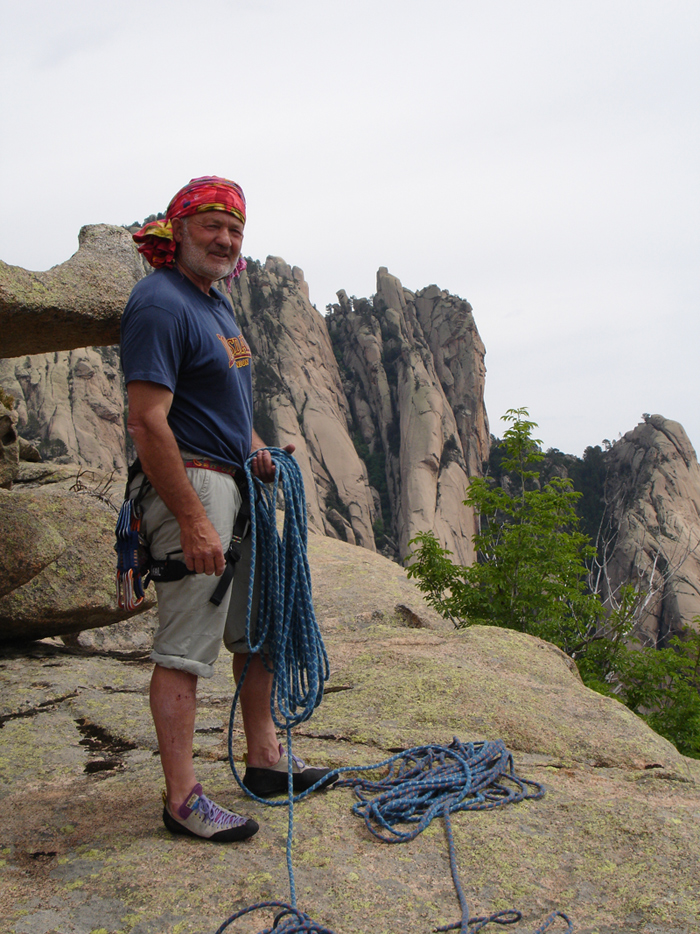
But look, look ahead: the Aiguilles de Bavella! Look at those red rocks rising into the sky. This morning they’re almost pink, pink and majestic and proud. These jagged peaks, these rocky walls, they are the towers of my castle. Beautiful, aren’t they?
I love listening to that silence within the silence, when I move through them, when I climb them. Vertiginous granite peaks, a wild landscape, sometimes intimidating, of a sublime brutality…
This physical, mineral contact with clean rock, this sense of pushing myself, always brings me great pleasure. Pleasure in the effort, pleasure in overcoming difficulty or escaping danger. Emotions at every step, I feel I am conquering, and at the same time I feel these needles accepting me.
I experience a moment of pride and contemplation, in harmony with nature. It’s as if they and I are gradually taming each other. I feel like thanking these pink ladies for letting me do something that not everyone gets to experience…
Ghjuvan Paulu Quilici